Cynthia Freeland but Is It Art? An Introduction to Art Theory Oxford University Press 2001
Only Is It Fine art?
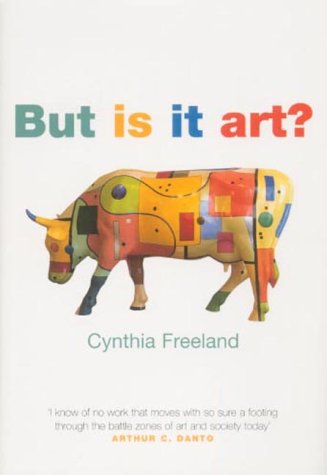
Cover illustration: Cross Burn down Cow, by William Conger
Published Oxford Academy Press, February 2001
Text: 220 pages
30 illustrations, viii colour plates
$16.95
In today's art world many strange, fifty-fifty shocking things qualify equally fine art. In this volume, Cynthia Freeland explains why innovation and controversy are valued in the arts, weaving together philosophy, art theory, and many engrossing examples. She discusses claret, beauty, culture, money, museums, sex, and politics, clarifying gimmicky and historical accounts of the nature, office, and estimation of the arts. Freeland propels u.s. into the future by surveying art web sites and CD-ROMs, along with cutting-edge research on the encephalon's role in perceiving art. This clear, provocative book volition engage the public and prove invaluable to introductory students and teachers in aesthetics and the arts.
Extracts
Selected Extracts from Only Is It Fine art?All texts copyright 2001 by Cynthia A. Freeland
Chapter 1. Blood and Dazzler
Claret and Ritual
But does blood in kooky modernistic (urban, industrial, First World) art hateful what it does in "primitive" rituals? Some people advocate a theory of fine art as ritual: an ordinary object or human action acquires symbolic and melancholia significance through incorporation into a conventionalities organisation shared by all participants. When the Mayan king shed claret earlier the multitude in Palenque by piercing his own penis and drawing a thin reed through it three times, he exhibited his shamanistic power to contact the country of the undead. Some artists now seek to recreate a similar sense of fine art equally ritual. Diamanda Galas fuses operatic wizardry, lite shows and glistening blood in her Plague Mass, supposedly to bewitch pain in the era of AIDS. Hermann Nitsch, the Viennese founder of the Orgies Mystery Theater, promises catharsis through a combination of music, painting, wine-pressing, and ceremonial pouring of animate being claret and entrails. You can read all well-nigh information technology on his web site at http://www.nitsch.org. Such rituals are non birthday alien from the European tradition: at that place is a lot of blood in its two primary lineages, the Judaeo-Christian and the Greco-Roman. Jahweh required sacrifices as parts of His covenant with the Hebrews, and Agamemnon, like Abraham, faced a divine command to slit the throat of his own child. The blood of Jesus is so sacred that it is symbolically boozer to this day by believing Christians as promising redemption and eternal life. Western art has e'er reflected these myths and religious stories: Homeric heroes win godly favor by sacrificing animals, and the Roman tragedies of Lucan and Seneca pile upward more body parts than Freddie Krueger in A Nightmare on Elm Street. Renaissance paintings showed the claret of martyrs with increasing realism; Shakespearean tragedy typically ended with major characters' deaths. But I doubt that when a performance artist uses claret now, it has genuinely effective ritual meaning. The ways audiences see information technology and react are different and they do not enter in with a shared belief and value system. Most modern fine art, in the context of theatre, gallery, or concert hall, lacks the background reinforcement of pervasive customs belief that provides pregnant in terms of catharsis, sacrifice, or initiation. Far from audiences coming to feel part of a group, sometimes they get shocked and abandon the community. This happened in Minneapolis when performance creative person Ron Athey, who is HIV-positive, cut the flesh of a swain performer on stage and and so hung blood-soaked paper towels over the audience, creating a panic. If artists only want to daze the bourgeoisie, it becomes pretty hard to distinguish the latest kind of art that gets written up in Artforum from a Marilyn Manson performance that includes Satanic rituals of creature sacrifice on stage. The cynical assessment is that claret in contemporary art does not forge meaningful associations, just promotes amusement and profit.
Chapter Four. Money, Markets, Museums
What'south a Poor Artist to Do?
No affiliate on fine art and money can be complete without mention of astronomical prices paid at art auctions, especially in the boom years of the 1980s. Prices of Van Gogh'southward works at sales in 1987, in detail, stunned the earth: His Irises sold for $53.9 1000000 and Sunflowers for $39.ix million. In the same yr, two of Van Gogh's other works went for $twenty million and $13.75 one thousand thousand. The irony was grotesque in light of the artist's ain poverty and despair over beingness unable to sell works during his lifetime. The idea that a work like the Mona Lisa is "priceless" makes it difficult to run across and appreciate as fine art (when i is lucky enough to become a second to stand before it). Can we ever over again see Van Gogh'southward works equally art rather than every bit huge dollar signs? Sometimes a museum capitalizes on our absorption with money. A membership solicitation brochure for Australia's National Gallery of Art from 1995 featured the controversy over its purchase of Jackson Pollock's painting Blue Poles for $i million (Aus). The brochure's cover showed a huge tabloid headline screaming about this painting that "Drunks Did It!" But on the inside of the brochure, the museum (and presumably its members) got the last express joy past pronouncing, "Now the world thinks information technology's worth over $20 meg. And information technology's all yours from $xiv.50 [i.due east., the price of a membership]." After succumbing to this appeal, will the new museum member really be able to look at Blue Poles for its creative value? Museums are only a function of the electric current story of the fine art market, because wealthy collectors worldwide have more buying power. The advert executive Charles Saatchi has been defendant of manipulating the market for the latest young and trendy artists through his sudden shifts in purchases or sales. His support of specific travelling exhibitions, similar the controversial Sensation exhibit of young British "Britpack" artists (cause of New York Mayor Rudolph Guiliani'south ire in 1999), has likewise been seen as suspect. Through promoting the exhibition, Saatchi raises the value of works that he owns. How tin can an creative person escape or confront the fine art marketplace, with its vagaries of trends and fickle favor?
Affiliate V. Gender, Genius, and Guerrilla Girls
A Feminine Essence?
Some women artists have been recognized, like Georgia O'Keeffe, who now has her ain museum. But the Guerrilla Girls complain that this piece of work is not treated on a par with men's: it is e'er downplayed by being labeled "female." In fact, Alfred Stieglitz, the gallery owner who later became O'Keeffe's husband. exclaimed when he start saw her paintings, "At final! Finally a adult female on canvass!" O'Keeffe always pooh-poohed the idea that her works were somehow "feminine," just many viewers share Stieglitz's gut reaction that they express a quality of female experience. Flowers are sexual organs, and O'Keeffe's large flower paintings oft depict immense and engorged stamens and pistils, delighting in petals' deep folds and plush textures. They practise evoke human genitalia and seem erotic. Judy Chicago, on the other hand, deliberately gives a sexual connotation to flower imagery on plates of The Dinner Party. She does not simply hint at simply really does draw female ballocks. Chicago sought a female representation of intimacies of the female body to annul the mostly male depictions of women in pornography and high art. The Dinner Party historic female bodily experiences by linking visual representations to texts that conveyed women'southward ability and accomplishment rather than passivity and availability. But since 1979 when The Dinner Party was kickoff exhibited, many critics, including feminists, accept criticized information technology equally either vulgar or too political, or else equally too "essentialist." Some critics contend that art that focuses so much on beefcake and sexual embodiment ignores of import aspects of women's social grade, race, historical circumstances, and sexual orientation. The Dinner Party is chosen simplistic and reductive�as if the achievements of women it is meant to celebrate are cancelled out by the omnipresent and identical vaginal imagery of each identify setting. A more recent strategy that other artists utilize, in contrast to Chicago'due south reductive and biological approach, is deconstruction: showing that femininity is the artificial product of images, cultural expectations, and engrained behaviors (such as ways of dressing, walking, or using makeup).
Chapter 7. Digitizing and Disseminating
A Commonwealth of Images
Anybody knows what the Mona Lisa and Michelangelo'south David wait like�or exercise nosotros? They are reproduced and then frequently that we may feel we know them even if we accept never been to Paris or Florence. Each has endless spoofs--David in boxer shorts or the Mona Lisa with moustache. Art reproductions are ubiquitous. We tin can now sit down in our pajamas while enjoying virtual tours of galleries and museums around the globe via the Spider web and CD-ROM. We tin explore genres and painters and zoom in to scrutinize details. The Louvre's web site offers spectacular 360-degree panoramas of artworks like the Venus de Milo. Such tours may get ever more multi-sensory by drawing on Virtual Reality (VR) technology, which includes things like goggles and gloves. Pilots, soldiers, medical students, architects, and phase set designers already use this technology in their training and piece of work. It is not simply visual art that has been made more widely attainable by new technologies of reproduction. Operas, plays, and ballet performances are regularly broadcast on TV, and more people know the music of Bach and Beethoven from CD'south or radio than from alive concerts in churches or symphony halls. If I adore the movies of the late Stanley Kubrick, I tin own copies in high-resolution DVD (letterbox format of course). Human experiences of art have been significantly inverse in this postmodern historic period of the Internet, videos, CD'south, advertizement, postcards, and posters. Simply for adept or ill? And how have artists responded? In this final chapter, I will consider the impact of new communications technologies on art. We will await "dorsum to the future" past exploring how art'due south past is digitally disseminated past futuristic technologies beyond the global village in the new millennium. 3 theorists will exist our guides: Walter Benjamin, Marshall McLuhan, and Jean Baudrillard. Their attitudes range from enthusiasm to cynicism.
Philosophy and the Arts course outline
Last Updated Dec 10, 2000
campbellheing2002.blogspot.com
Source: https://www.uh.edu/~cfreelan/aesth/OUP.html

Postar um comentário for "Cynthia Freeland but Is It Art? An Introduction to Art Theory Oxford University Press 2001"