What are the steps to determine opportunity cost?
What is the Opportunity Price of a Decision?
Opportunity cost is one of the primal concepts in the study of economics and is prevalent throughout various controlling processes. The opportunity cost is the value of the next best culling foregone. In simplified terms, it is the cost of what else ane could have chosen to practise.

Considering Alternative Decisions
Principles of management accounting or corporate finance dictate that opportunity costs ascend in the presence of a choice. If there appears to be just one option presented in the decision-making procedure, the default alternative is "laissez-faire" (to practice nothing) with an associated price of zero. Notwithstanding, if a decision-maker must choose between Decision A or B, the opportunity cost of Decision A is the cyberspace benefit of Determination B and vice versa.
How is Opportunity Toll Calculated?
In financial analysis, the opportunity toll is factored into the present when computing the Net Present Value formula .
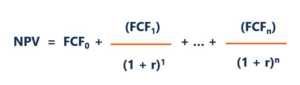
Where:
NPV: Cyberspace Present Value
FCF: Free greenbacks menstruum
r: Discount rate
n: Number of periods
When presented with mutually exclusive options, the controlling rule is to cull the project with the highest NPV. All the same, if the alternative project gives a unmarried and immediate benefit, the opportunity costs can be added to the total costs incurred in C0. As a effect, the determination rule so changes from choosing the projection with the highest NPV to undertaking the project if NPV is greater than zero.
Fiscal analysts use fiscal modeling to evaluate the opportunity cost of alternative investments. By edifice a DCF model in Excel, the annotator is able to compare dissimilar projects and appraise which is most bonny.
Application of Opportunity Cost
For example, assume a firm discovered oil in one of its lands. A state surveyor determines that the land can be sold at a price of $twoscore billion. A consultant determines that extracting the oil will generate an operating revenue of $eighty billion in present value terms if the firm is willing to invest $30 billion today.
The accounting profit would be to invest the $xxx billion to receive $fourscore billion, hence leading to an bookkeeping profit of $l billion. However, the economic profit for choosing to excerpt will be $10 billion because the opportunity cost of non selling the land will be $40 billion.
Other Costs in Decision-Making: Incremental Costs
A firm may choose to sell a product in its current state or process it further in hopes of generating additional revenue. For example, crude oil tin can be sold at $40.73 per barrel. Kerosene, a product of refining crude, would sell for $55.47 per kilolitre. While the price of kerosene is more bonny than crude, the firm must determine its profitability by considering the incremental costs required to refine crude oil into kerosene.
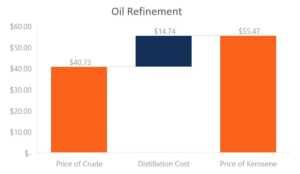
In this case, the firm will be indifferent to selling its product in either raw or processed grade. Yet, if the distillation cost is less than $xiv.74 per barrel, the firm will profit from selling the processed production. If not, it would be better to sell the product in its raw class.
Other Costs in Decision-making: Sunk Cost
A sunk toll is a cost that has occurred and cannot be inverse past present or future decisions. As such, information technology is important that this cost is ignored in the decision-making process.
For instance, assume that the firm described above has invested $thirty billion to start its operations. However, a fall in demand for oil products has led to a foreseeable revenue of $fifty billion. Every bit such, the profit from this project volition lead to a net value of $20 billion. Alternatively, the business firm can still sell the land for $40 billion.
The determination in this state of affairs would be to continue production as the $fifty billion in expected revenue is still greater than the $40 billion received from selling the land. The $30 billion initial investment has already been made and will non be contradistinct in either choice.
Other Resource
CFI is the official provider of the global Capital Markets & Securities Annotator (CMSA)® certification program, designed to aid anyone become a world-class financial annotator. To proceed advancing your career, the additional CFI resource below will be useful:
- Price Behavior Analysis
- Action-Based Costing
- WACC Formula
- Types of Financial Models
campbellheing2002.blogspot.com
Source: https://corporatefinanceinstitute.com/resources/knowledge/economics/opportunity-cost/

Postar um comentário for "What are the steps to determine opportunity cost?"